
Interpeter (Simplified JavaScript)
Easy JS (Simplified JavaScript)
-
Alphabet
- Keywords: bool, const, false, float, else, if, int, print, true, string, while
- Identificators: [A-Za-z_]+[A-Za-z0-9_]*
- Integer type: -?([1-9][0-9]*|0)
- Real type: -?[0-9]*\.[0-9]*
- String type: [^"\n\r\t]*
- Meaningful separators: '{', '}', '(', ')', '.', ',', ';', '−', '+', '*', '/', '%', '^', '!', '!=', '==', '&&', '||', '>=', '<=', '>', '<', '='
- Minor separators: space, tab, line break
- Comments: same as in JS
-
Syntax
- program = { declaration | statement | block }
- declaration = ( typeSpec id [ "=" expression ] ) | ( "const" typeSpec id "=" expression ) ";"
- typeSpec = "bool" | "int" | "float" | "string"
- expression = logic1 { "||" logic1 }
- logic1 = logic2 { "&&" logic2 }
- logic2 = logic3 [ ( "==" | "!=" ) logic3 ]
- logic3 = term [ ( "<" | ">" | "<=" | "=>" ) term ]
- term = factor { ( "+" | "-" ) factor }
- factor = power { ( "*" | "" | "%" ) power }
- power = operand { "^" operand }
- operand = [ "-" | "!" ] ( id | literal | "(" expression ")" )
- literal = "true" | "false" | float | int | string
- statement = selStmt | iterStmt | printStmt | exprStmt
- selStmt = "if" "(" expression ")" block [ "else" block ]
- block = "{" program "}"
- iterStmt = "while" "(" expression ")" block
- printStmt = "print" expression ";"
- exprStmt = id "=" expression ";"
-
Semantics
- Constants
They can be either boolean (“false”, “true") or integers. (“-1”, “203”, ...) and floating point numbers (“-1030.02”, “0.0”, ...), so are the strings (“abc", “V1a", ...). - Expressions
They are made up of brackets, variables, constants, and algebraic operations. - Algebraic operations
"+" – addition
"−" – subtraction
"*" – multiplication
"" – division (the result can be decimal)
"%" – remainder of division
"^" – exponentiation - Operators
- Assignment operator
The assignment operator is used to assign a value to a variable. It has the form subject = object. The operator can assign the result of evaluating an expression to a variable.
Example:float fS = f1 + f2;
- Logical operators
"!" – logical NOT
"&&" – logical AND
"||" – logical OR
"!=" – not equal
"==" – equal
"<=" – less or equal
">=" – greater or equal
"<" – less
">" – greater - The output operator
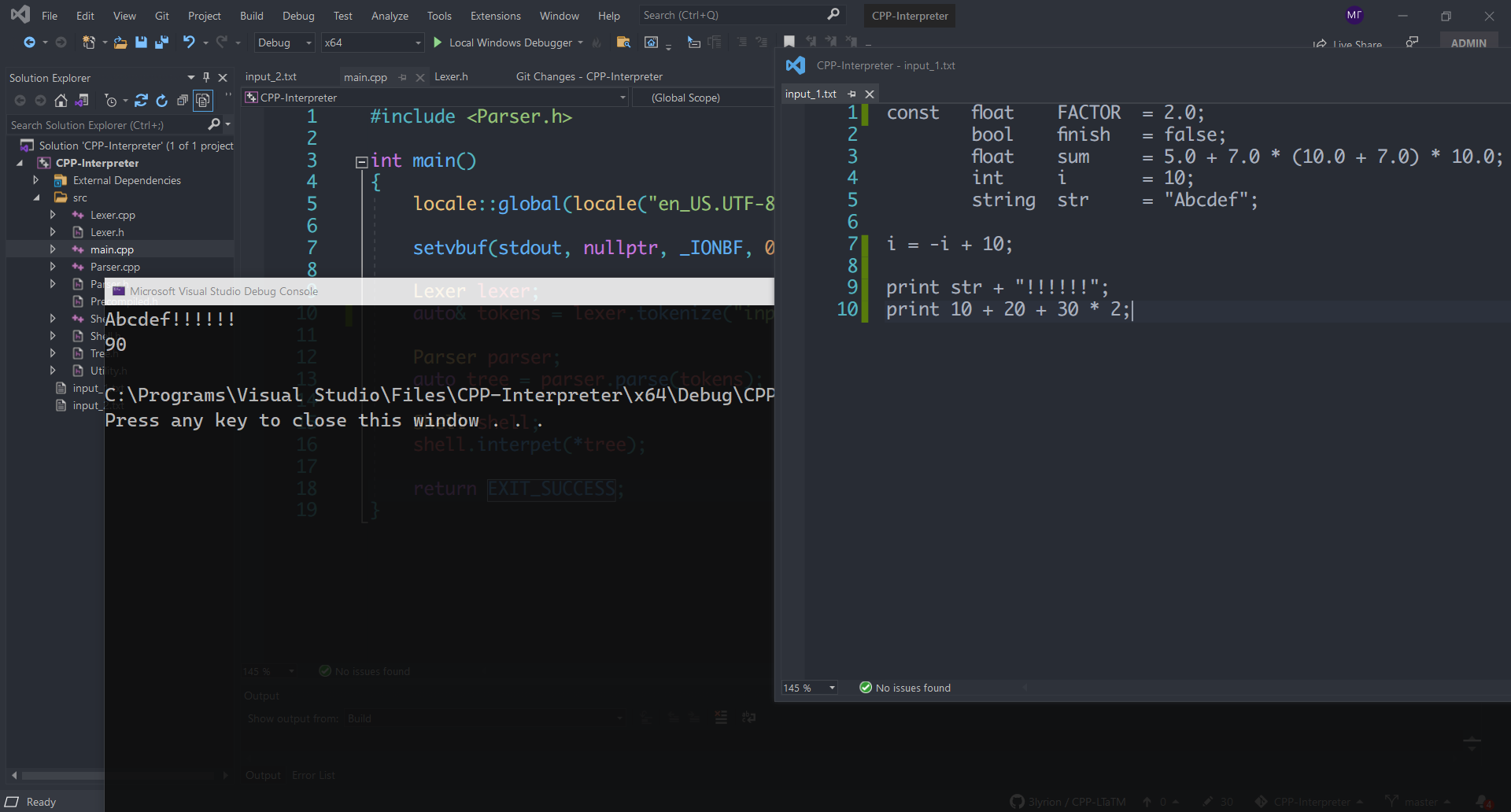
The output operator outputs the value of a variable from a new line.
Example:print num; print "output";
- The loop operator
Organizes the repetition of the execution of a sequence of program statements.
Example:while (sum != 10) { sum = sum + 2; }
- Assignment operator
- Priority of operations
Priority Operations 1 (, ) 2 ^ 3 !, –a 4 *, /, % 5 a + b, a – b 6 <, >, <=, => 7 ==, != 8 && 9 || 10 print
- Constants
-
Usage example
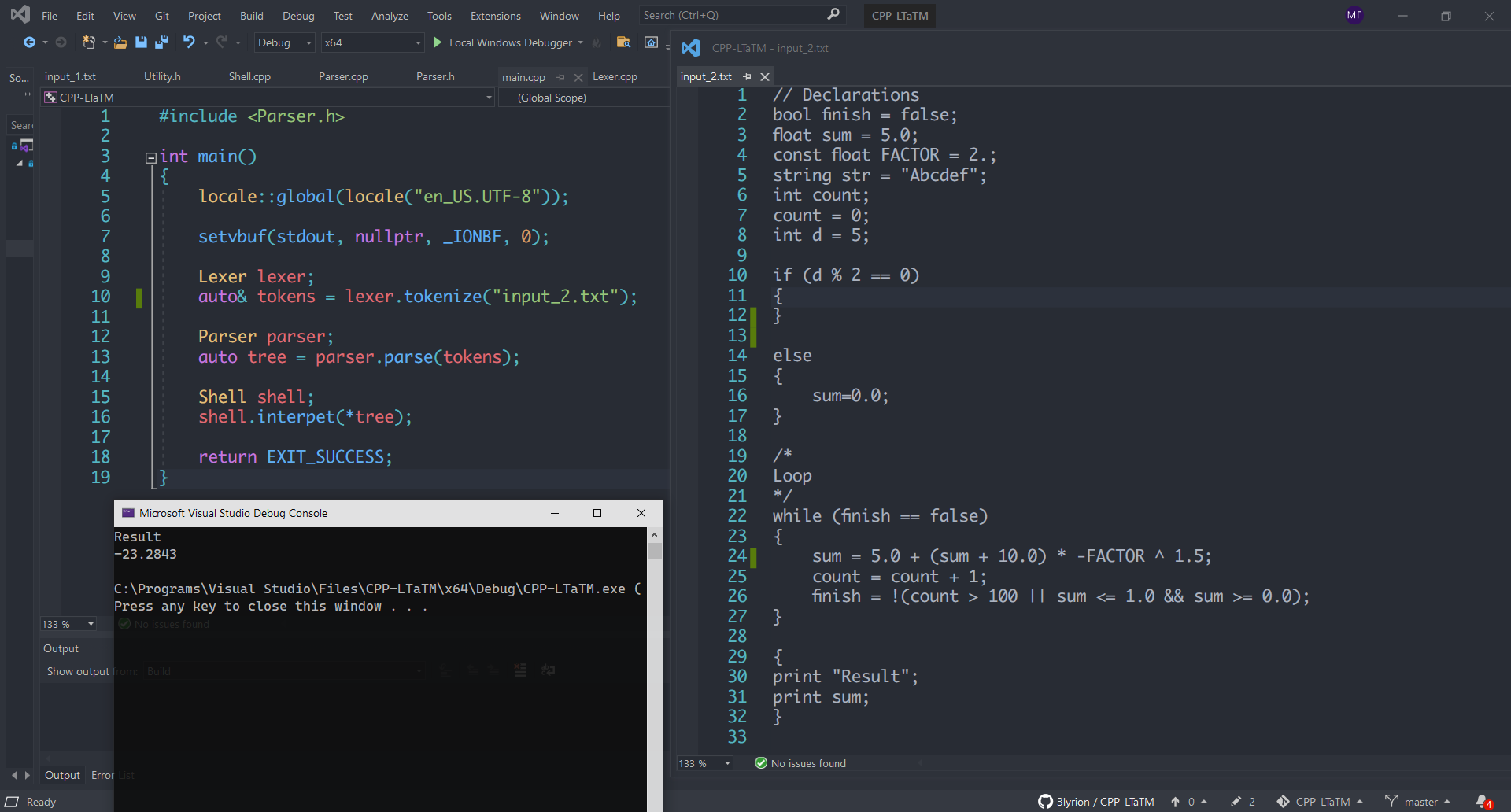
// Declarations
bool finish = false;
float sum = 5.0;
const float FACTOR = 2.;
string str = "Abcdef";
int count;
count = 0;
int d = 5;

if (d % 2 == 0)
{
}
else
{
    sum=0.0;
}

/*
Loop
*/
while (finish == false)
{
    sum = 5.0+(sum+10.0) * -FACTOR^1.5;
    count = count + 1;
    finish = !(count > 100 || sum <= 1.0 && sum >= 0.0);
}

{
print "Result";
print sum;
}
The Interpeter
- Lexer
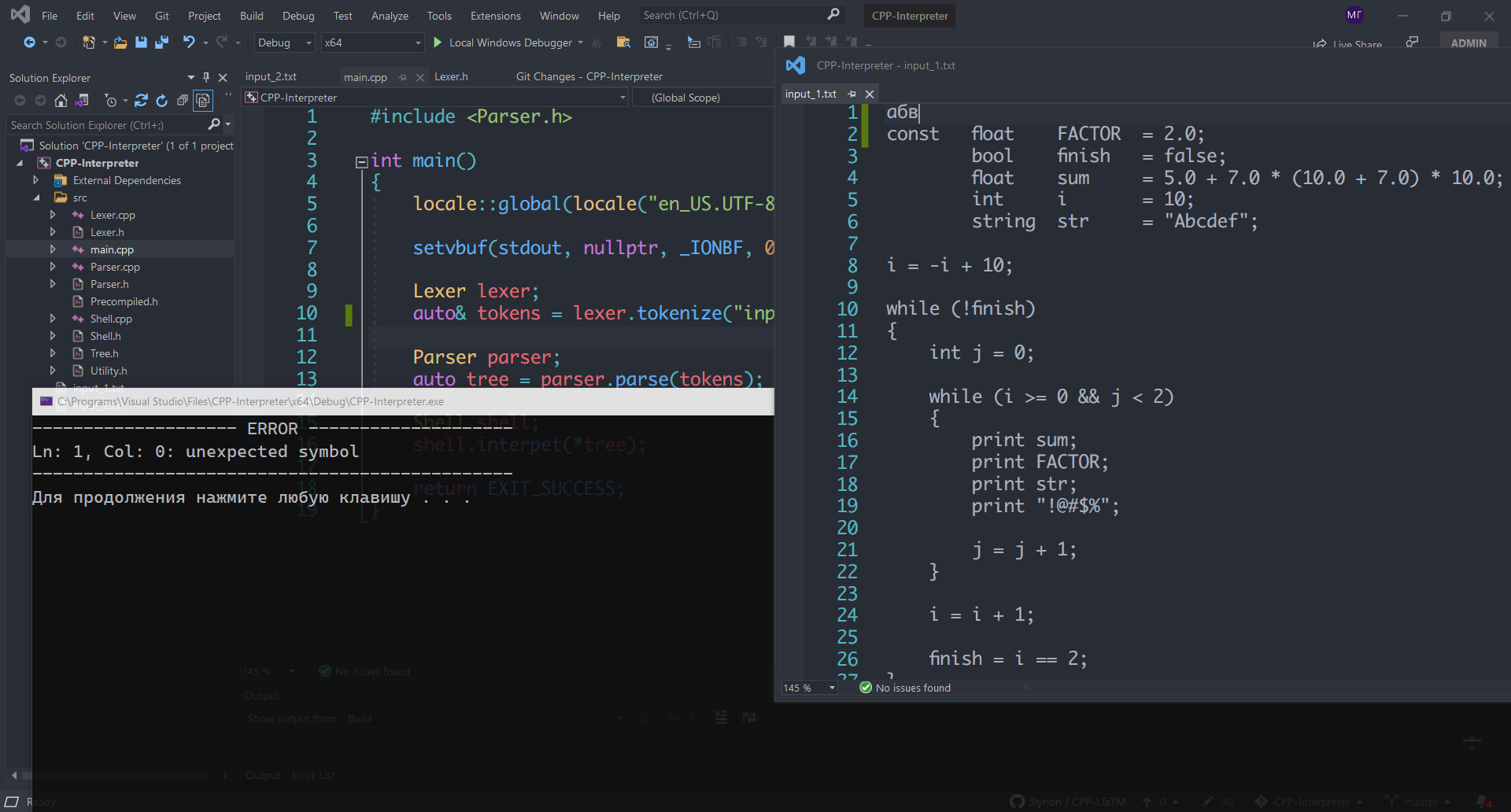
Reads the file character by character and searches for suitable tokens. If an unexpected character or an unclosed multi-line comment is found, it returns an error. - Parser
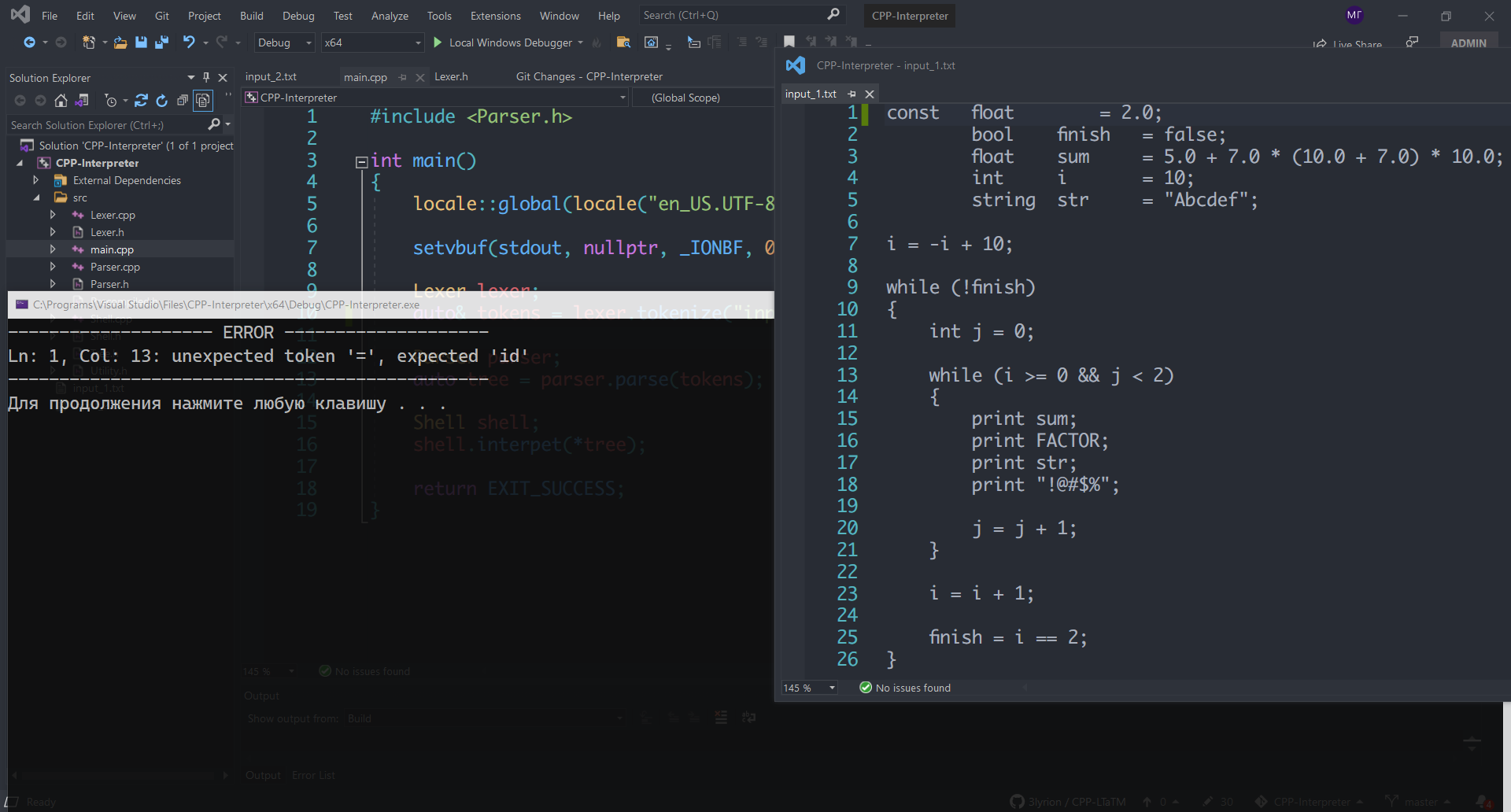
Finds syntactic constructions and generates a token tree for the Shell (interpretation tree). When an unexpected token is detected, it returns an error. - Shell
It moves through the interpretation tree and performs the corresponding operations.
Features of the work:- For each scope, there is a list of variables that is destroyed when closed; each calculated expression automatically uses a new temporary scope.
- There is no recursion; nested expressions are transformed into a single one, and then this expression is evaluated.
- An expression consisting of more than one token is converted to the Reverse Polish Notation format, and then calculated.
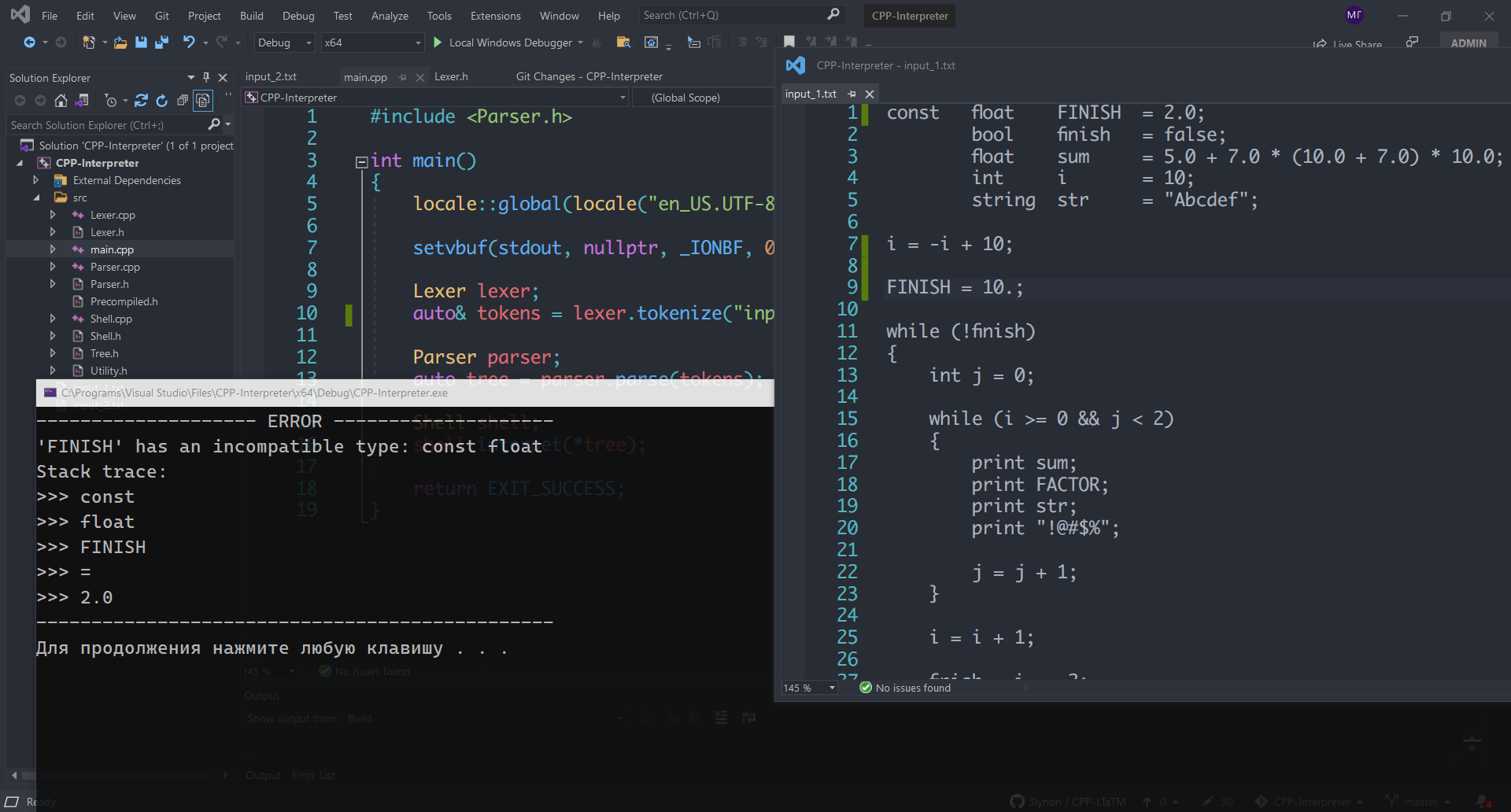
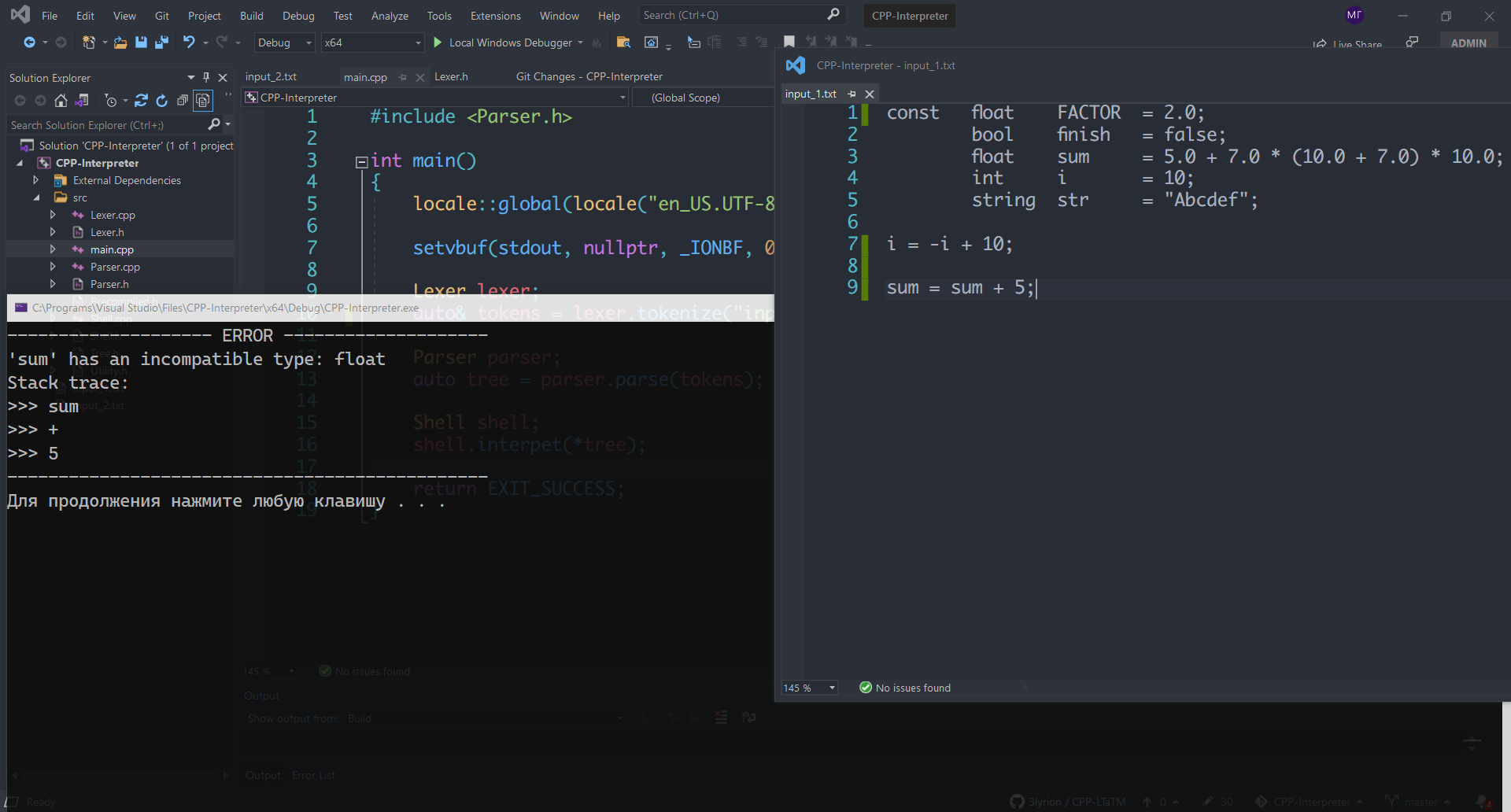
- Incompatibility of variable types, including an attempt to re-assign a value to a constant variable.
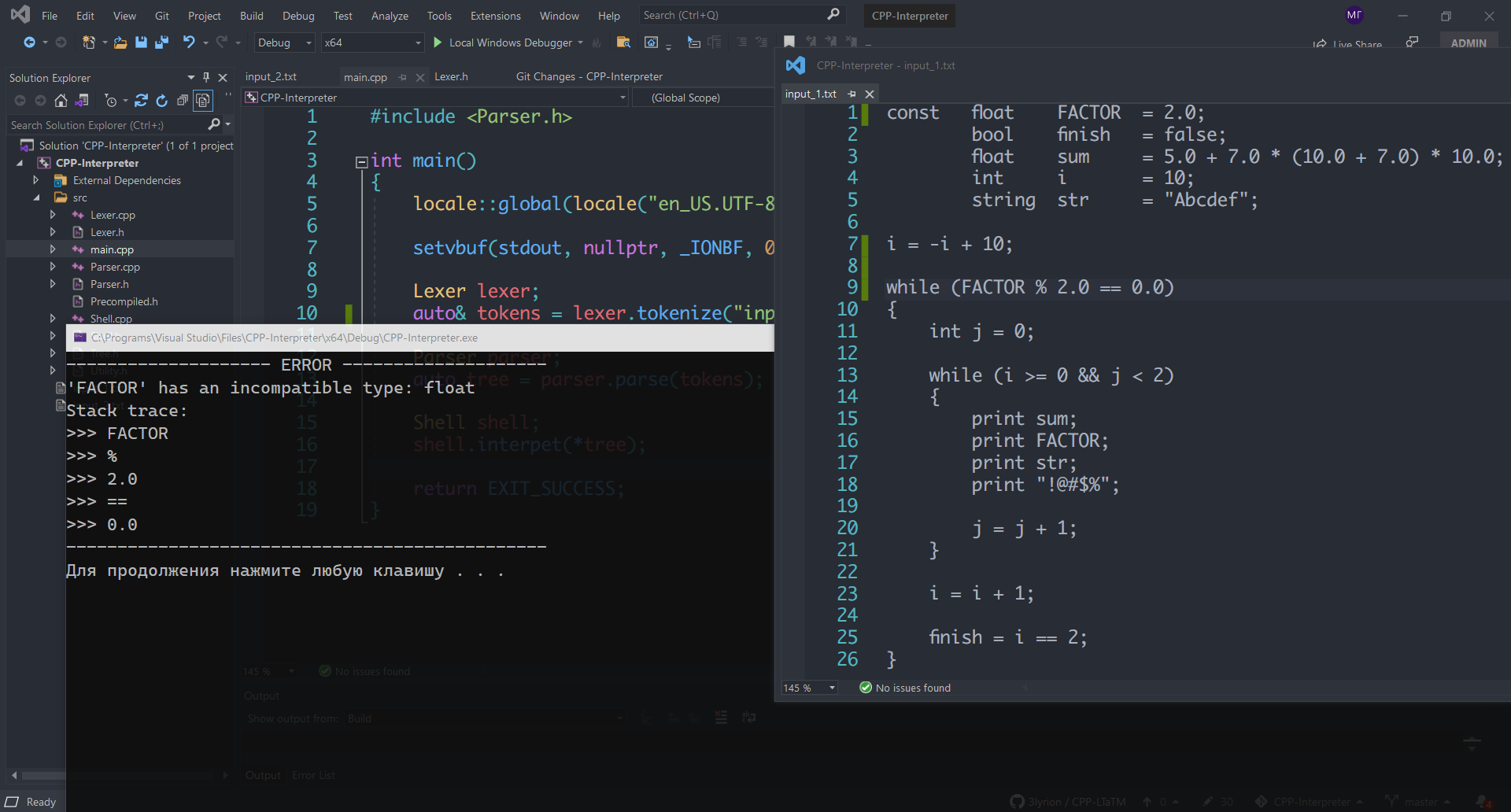
- Unsupported operation for the data type.
- Re-declaring a variable.
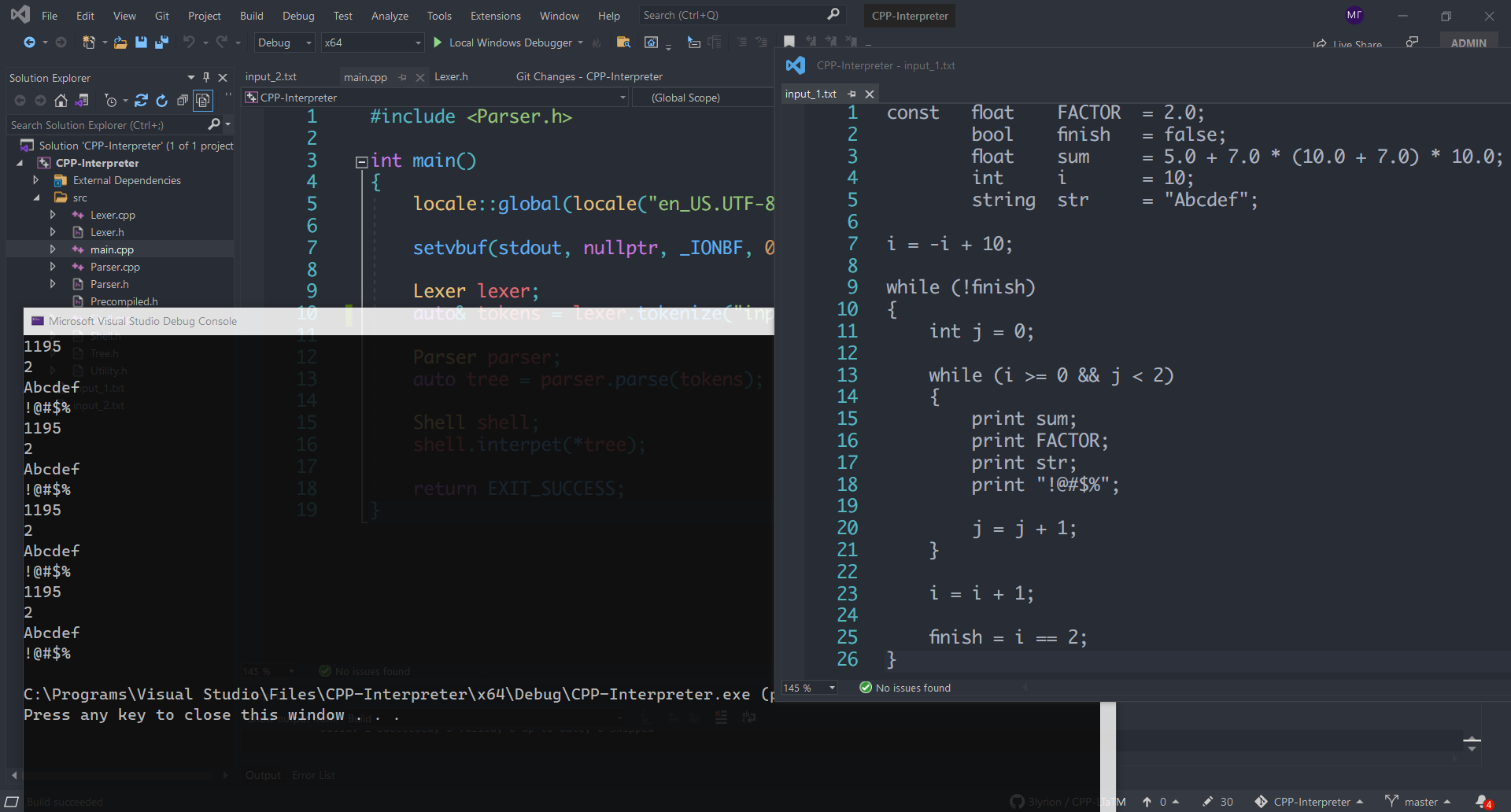
Demonstration
Links